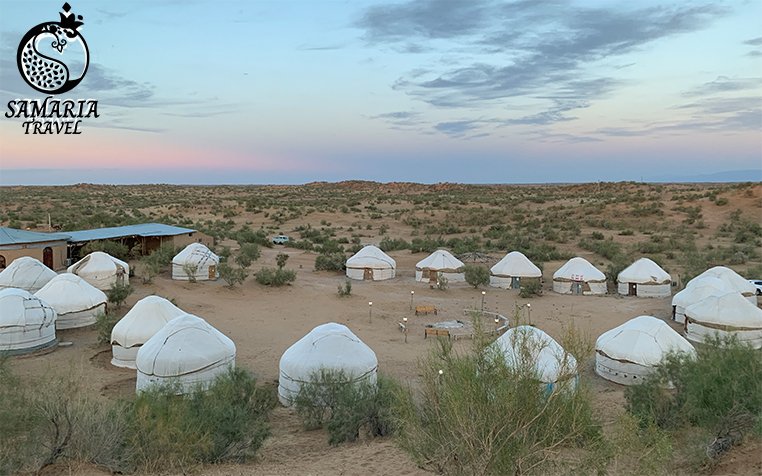
Uzbekistan private tour in August begins in Tashkent and continues with a domestic flight to Nukus, followed by a visit to the Muynak Ship Cemetery and an overland transfer from Nukus to Khiva via the ancient desert fortresses. In Khiva, the country’s first UNESCO-listed city, travelers explore its remarkably well-preserved fortress and open-air museum. The journey then proceeds through the Red Desert to Bukhara, a historic city renowned for its ancient old town and its significant role as a major center of trade along the Silk Road. From Bukhara, the route continues to Nurata, where guests stay in traditional desert yurts, visit a mountain village, and enjoy a short hiking experience. The tour then continues to Samarkand, the former capital of Timur’s empire, followed by a day trip to Shakhrisabz, Timur’s birthplace, traveling through a scenic mountain pass that reveals the landscapes beyond the main cities. The journey concludes with a high-speed train ride from Samarkand back to Tashkent. Throughout the tour, travelers are offered ample free time, complemented by the services of knowledgeable local guides who provide insightful historical commentary, ensuring a well-balanced, informative, and enriching private travel experience.
ITINERARY & DETAILS
Day 1: Tashkent arrival
Arrival in Tashkent. Arrival in Tashkent on the first day, allowing travelers to settle in and rest after their flight.
Welcome to Uzbekistan. Upon arrival, the driver will meet you outside of the airport with sign of your name and provide a smooth transfer to your hotel for a comfortable and stress-free start to your journey.
Day 2: Tashkent city tour
Tashkent is the capital of Uzbekistan and has approximately 3 million inhabitants. The city is located in the north eastern part of the republic, in the valley where the river Chirchik is located. In the North of Tashkent the snow-covered tops of Big and Small Chimgan mountain can be seen. Tashkent is the fourth largest in the Commonwealth of Independent States after Moscow, St Petersburg and Kiev.
The sightseeing in Tashkent city:
Earthquake Memorial— this memorial is devoted to the tragic date of earthquake in Tashkent on April 26th of 1966 and is erected in the approximate spot of the earthquake epicenter.
Khazrati Imom Complex (XVI-XX centuries) the historical spiritual heart of the city (consists of functioning Friday mosque “Khazrati Imom Mosque” from 2007, Barak-Khan Madrassa from XVI-XVIII centuries—present-day serving as shopping place, Tellya Sheikh Mosque from XIX century, Muyi Moborak Library— holds rare Oriental manuscripts collection, among which the world-famous Caliph Osman- Koran from the VII century and the mausoleum of Abu Bakr Mohammed Kaffal Shashi, the first Koran preachers of Central Asia, who was also a famous scientist).
The market Chorsu (“four roads” in Uzbek, the commercial heart of the city and has been for hundreds of years).
Metro riding (the only Central Asian Underground, built in 1977).
Amir Timur Square—the centre of the modern city, is green space with plenty of flowers and fountains. The square covers the most important buildings both political and cultural. In the middle of the square is the statue of Amir Timur (known in Europe as Tamerlane) on horseback, hotel “Uzbekistan” which was built in 1974, University of Law (former Women’s Gymnasium), Museum of Amir Timur, well-known Tashkent Clock Towers (the first tower was constructed in 1947 to house the clock mechanism from Eastern Prussia, a war trophy brought back to Tashkent by watchmaker Ayzenshteyn), and Uzbekistan Forums Palace.
Day 3: Tashkent—Nukus—Muynak—Nukus
In the morning, you will meet your driver and be transferred to the domestic airport to take your flight to Nukus.
Nukus is the center of Karakalpakstan an autonomous republic, which is located in the north-western part of Uzbekistan. Start to drive to Muynak 210 km (takes more than 2 hours and 30 minutes). Muynak (“Mo’ynoq” in Uzbek, used to be harbor town. In just 60 years it has gone from being a wealthy fishing port to a small town where skeleton ships lie broken in the desert). After sightseeing in Muynak transfer back to Nukus.
Day 4: Nukus—3 fortresses—Khiva
Qala trip (“Fortress” in Uzbek)
The ruins of over a dozen walled towns, palaces and forts, some well over 2000 years old, stand half-forgotten in the semi-desert east and north of Urgench in southern Karakalpakstan. The area’s traditionally name, Ellik Qala (the 50 fortresses) gives a stark indication of what lies beneath the desert sands. There are about 20 forts and you will visit three of the most impressive forts: Toprak Qala and Ayaz Qala.
Kyzyl Qala (“Red fortress” in Uzbek)— located in modern Karakalpakstan, Uzbekistan and it was an ancient fortress in Khorazm built in the 1st -4th centuries AD. Kyzyl Qala fortress buried in the desert for centuries before being discovered by Professor Tolstov in 1938.
Toprak Qala (“Sand” in Uzbek)— used to be the region’s biggest city (350 meters by 500 meters) until the destruction canals left it marooned in the desert sands. The Russian archaeologist Tolstov excavated the palace friezes in 1938 dating from the 2nd and 3rd century AD.
Ayaz Qala— is a “must see” fort in the desert. The external walls, built upon a flat hilltop, have survived since at least the 4th century BC, the guests can clearly see the scale of the site and even today sections of wall survive that are 10 meters high. After forts sightseeing transfer to the Khiva and check in to the hotel.
After the tour drop off at hotel in Khiva.
Day 5: Khiva city tour
Khiva, one of the most ancient cities of Central Asia, has a 2500-year-old history. Khizauv “Fort”, Kheykanik (the name of canal which run in the area), Kheykanik, Kheyvak and Khiva are some the names given to this unique city.
The sightseeing in Ichan Qala Fort:
The sightseeing in Khiva (walking tour):
Muhammad Amin Khan Madrassa— (1855) the largest in the city and named after one of the city’s more impressive khans. Madrassa’s 125 hujra (rooms) cells, once housing the madrssa’s students, are currently home to the atmospheric Hotel Khiva.
Kalta Minor— belong to Muhammad Amin Khan Madrassa and supposed to be the world’s tallest minaret, but abandoned as too costly after the khan was murdered three years later.
Kunya Ark (“Kuhna Ark” in Uzbek)— fortified palace was built in XVII century by Arang Khan, son of Anusha khan. It was town within town, with its own defensive walls, mosques and offices, stables, arsenal and mint as well as residential areas.
Muhammad Rakhim Khan Madrassa— (1871) a museum dedicated to the khan, who was also known for his poetry, written under the name Feruz Shah.
Pakhlavan Mahmud Mausoleum— one of the holiest sites in Khiva which commemorates the poet, wrestler and patron saint of Khiva who died here in 1325. The XIX century tomb contains some of the city’s best tile work and also the largest cupola in Khiva.
Day 6: Khiva city tour
Islam Khoja Madrassa— is named after the enlightened early XX century grand vizier who built public school and modern hospital. Built in 1908, it is the last Islamic monument to be built in the city before the arrival of the soviets.
Islam Khoja Minaret— the tallest minaret in the city (Note: climbing the minaret 100.000 sum per person and it is not included to the tour price).
Juma Mosque— (1788) supported by a dense forest of 213 wooden pillars that are cleverly arranged to allow the entire congregation a view of the mihrab (niche pointing the derection to Mecca). Aptly, the mosque holds an exhibition of carved karagach (elm) wood.
Tash Hauli Palace (“Stone Palace” in Uzbek)— (1832-38) home to the court of Allah Kuli Khan (1826-42) and a highlight of the city. A secret corridor connects the fabulously decorated inner harem.
Enjoy a walk on the walls of Khiva’s inner fortress, from the northern gate to the western gate.
Day 7: Transfer from Khiva to Bukhara by car (no guide for today)
Transfer from Khiva will be arranged by car, crossing the Amu Darya River (known in antiquity as the Oxus) and traversing the vast Kizilkum Desert, ensuring a smooth and scenic journey toward the city Bukhara remarkable historical city.
Day 8: Bukhara city tour
Bukhara, one of the most ancient cities of Central Asia, has a 2500-year-old history. Bumichkat “New Castle”, Al Madina as-sufriyya “Copper City”, Madinat at-tujjor “City of Traders”, Foxira “Honorable City” are some the names given to this unique city.
The sightseeing in Bukhara city (walking tour)
Labi Hauz Complex (“The edge of the pond” from Persian) constructed by Nadir Divan Begi, The Grand Vizier of Bukhara, around 1620.
Statue of Hodja Nasruddin— the homespun philosopher and humourist on his donkey. Elsewhere in the world he is generally accepted as Turkish, but Uzbeks claim he was born in Bukhara and is one of their own.
Poi Kalon complex (“The foot of tall” in Uzbek) from XII-XVI centuries. Consisting of mosque, madrassah and minaret, one of the great centre of trade and scholarship along the Silk Road. The beauty of the minaret amazed Genghis Khan (Temuchin or Temujin).
Trading domes—Tok-i-Zargaron (1570, Jewellers’ Bazaar), which once cornered the local market in lapis and rubies from Badakhsan. Tok-i-Tilpak Furushon, or Cap Makers’ Bazaar, which once specialized in gold-embroired skullcaps, fur hats and illustrated manuscripts, all of which had to be protected from the glare of the sun. Tak-i-Sarrafon—money changers’ dome.
Abdulazizkhon madrassa, constructed in 1652, was commissioned to commemorate the ruler’s victory over the Mughal army in Balkh. Occupying a footprint of 60 by 48 meters, the complex is distinguished by its sumptuous decorative programme, featuring vibrant mosaic work in a profusion of colours and complemented by equally striking ganch stalactites that enhance the architectural splendour of the site.
The Citadel Ark (I-XX centuries)— (visit from outside) the construction of the citadel is dated to beginning of the 1st millennium BC. During the history the fortress has been destroyed several times but has been restored again. All buildings of the citadel have been reconstructed mainly during the XVIII-XX centuries.
Day 9: Bukhara city tour
The sightseeing in Bukhara city (outside of old town)
Chor Minor— an unusual madrassah in Bukhara. The name means “Four Minarets”. Each tower has a different decoration.
Naqshbandi Sufism complex— Islamic saint Bakhauddin Naqshband, the famous Asian philosopher and Sufi, the founder of a Sufi order which was later named Naqshbandi, lived in XIV century. He became patron saint and the complex is the holiest site in Bukhara. He made 32 times the Hajj pilgrimage to Mecca and local people consider this place as little Mecca.
The summer palace of Bukhara’s emirs— the palace was built in 1911 for the last emir, Amir Alim Khan, the building compound elements of both Russian and traditional Bukharan architecture.
Ismail Samaniy mausoleum— the oldest, best preserved and most breathtakingly original building in Bukhara.
Day 10: Bukhara-Nurata-Lake Aydarkul-Yurt Camp
Nurata—this city is surrounded by the Nurata Mountains. Nurata (“Nur means Light or Holy and Ata means Father”), this ancient town held a strategic position on the frontier between the cultivated lands and the steppe. Population of the town is 32,000 people and renowned for marble and astrakhan for production, Nurata has retained some of the holy sites that attracted pilgrims from all over Central Asia.
Visiting sights in Nurata:
Chashma Spring—this Spring linked to Hazrati Ali (son-in-law of the Prophet Muhammad). The centre of the complex is a pool where the faithful come to collect water as a good luck and health to relatives and friends. Regardless of the time of the year, the mineral-laden spring water is said to remain at consistent 19 °C. The population of Marinka fish in the pool is thriving as it is considered as a holy spot and hence no-one is allowed to catch them.
Alexander’s Fort—it is strategically located on the top of the hill to the south of the town, and Uzbek sources suggest that Alexander instructed one of his generals to build an impenetrable fortress here while he continued his conquest of Bactria and Sogdiana. When Alexander returned, his troops could neither break down the gates nor scale the walls, such was the strength of the construction.
Drive to Lake Aydarkul (60 km)
Lake Aydarkul was created in 1969, when catastrophic springfloods made people drain excess water from the Syrdarya River into the Arnasay depression. Since then Aydarkul has been steadily growing in size. Nowadays lake covers an area of 4,000 square kilometers.
After visiting Lake Aydarkul drive to Yangiganzan to yurt camp (40 minutes’ drive). Upon arrival, travelers check in to yurt. Travelers sleep in the bed it might be a bit hard and there is an electricity inside of the yurt. Activities to do in yurt camp: camel riding, watching the birds and after dinner live music by Kazakh musician around the campfire.
Overnight in a yurt.
Overnight in Yurt Camp (shared bathroom facilities)
Day 11: Yurt Camp—Asraf (or Hayat) village
Embark on a transfer from the yurt camp to a small village nestled in the mountain area, where you can immerse yourself in authentic village life. Enjoy a short hiking excursion through the surrounding landscapes, followed by a traditional homemade dinner served in a local guest house, providing a genuine and memorable cultural experience.
Overnight in guest house (shared bathroom facilities)
Day 12: transfer to Samarkand
After staying at the guest house in the mountains, you will be transferred to Samarkand. Upon arrival, you will check in and have some free time to relax.
Day 13: A day trip from Samarkand to Shakhrisabz
Day trip to Shakhrisabz from Samarkand avoids the hassle of renting a car and allows travelers to explore the beautiful landscapes and historical monuments beyond the city through a convenient 7-hour excursion, during which they can enjoy the stunning nature outside of Samarkand, breathe fresh mountain air, observe the unusual shapes of mountain stones, visit the market located at the top of the mountain, and discover the remarkable historical monuments in Shakhrisabz
Tahtakaracha Pass
The first stop is a photo opportunity to capture the unusual shapes of the stones, among which the heart-shaped stone is particularly well-known. This site is also popular among local residents, functioning as a small recreational park that offers activities such as a short zip line, sliding, and archery. During the Soviet era, this location was used as a filming site for the movie Apache. Travelers can also enjoy views of the snow-capped mountains, with snow typically visible from November to March.
The second stop is the local market situated at the top of the Takhtakaracha Pass, where travelers can find a variety of dried fruits, mountain herbs, and traditional dried cheese. It is an excellent place to shop for local products or capture photographs of the vibrant market atmosphere. The peak of the pass stands at an elevation of more than 1,620 meters.
The third stop, on a clear day, offers a scenic panoramic viewpoint overlooking the town of Kitob in the Kashkadarya province, situated just beyond the peak of the pass.
When travelers reach the city meet local guide in Shakhrisabz and have a city tour
The Palace Complex of Ak-Saray
Ak Saray Palace (“a white palace” in Uzbek) built in 1380-1404. Amir Temur gathered its craftsmen to his hometown to build his greatest palace, similar in structure to Samarkand’s Bibi Khanum Mosque. The name Ak-Serai (White Palace) symbolizes his noble descent, not the dominant colour, for blue, green and gold patterned the vast mosaics.
Statue of Amir Timur
Statue of Amir Temur— there are three huge statues of Temur: one is in Samarkand, one is in Tashkent and the third is in his hometown Shakhrisabz in standing position. The bronze statue weighs 20 tons and 9 meters high built after the Independence (1991).
Dor Us-Siyodat
Complex of Dor-us Siyadat (“place of sadness” in Uzbek) from XIV century. It arose on the death of his eldest and favorite son Jahangir, killed in 1375 (aged only 22). When another son, Umar Sheikh, joined Jahangir in 1394, Temur even built himself a crypt.
Dorut Tilovat
Dor-ut Tilavat (“place of praying” In Uzbek) from XIV-XV centuries, contains the Kok Gumbaz Mosque (1435) built by grandson of Temur Mirzo Ulugbek, the mausoleum constructed by Amir Temur in 1373-1374 for Sheikh Shamseddin Kulyal, a Sufic leader and spiritual advisor of Temur’s father , Taraghay.
Day 14: Samarkand city tour
Samarkand, one of the most ancient cities of the world, a contemporary of the Rome, Athens and Babylon, has a 2750-year-old history. “The Mirror of the World”, “The Garden of the Soul”, “The Jewel of Islam”, “The Precious Pearl of the Moslem World” are some the names given to this unique city. In ancient Greece, this city was known as Marakanda.
Gur-Amir mausoleum (“the tomb of the king” in Uzbek) must see sight in Samarkand from XV century the final resting place of Temir. The mausoleum was originally planned for temur’s favourite grandson, Muhammad Sultan but Samarkand was deemed a more fitting resting place.
Registan square (“sandy place” in Uzbek) from XV-XVII centuries. A spectacular architectural ensembles, with fantastic Islamic designs and calligraphy etched into the facades of its mosques and madrassahs.
Ulugbek Madrasah built between 1417 and 1420 is the oldest madrasa in Registan square. This construction work was carried on under Ulugbeg (the Astronomer King, the author of astronomic tables known throughout the world), Temur’s grandson, who was both an eminent ruler and scholar.
Tilya-Kori Madrasah means Gold-covered madrasa was built in XVII century in Registan square. This is the one madrasa the travelers must go inside: the golden ceiling of the mosque, to the left of the courtyard, is utterly enthralling, and it is this gilt that gives the madrasa its name.
Sher Dor Madrasah means the tiger or lion madrasa built between 1619 and 1636 by Yalangtush Biy, must be one of the most-photographed buildings in existence.
Bibi Hanim mosque XV century. The mosque was built in honour of Temur’s chief wife, Saray Mulk Khanum.
Local Siab market (“black river” in Uzbek). Travelers can find in this market spices, fresh and dry fruits and different souvenirs
Day 15: Samarkand city tour
Samarkand Handmade Paper Centre— for centuries Samarkand was famous for its mulberry paper and famed for its durability and resistance to insects. Production died out in the 18th century and this UNESCO backed project in the eastern suburbs aims to revive the 2000-year-old tradition. Guests can see process of making Samarkand paper from mulberry bark.
The Ulugbek Observatory, built by Amir Temur’s grandson astronomer-king Ulugbek in XV century.
The museum of Afrasiab (the history museum of Samarkand and the highlight of this place is the original frescos of Turk Khanate “Turk kingdom” from VII century).
The complex Shahi Zinda (“alive king” in Uzbek) from XII-XX centuries. Burial place of royal persons and nobles. One of the most spiritual places in Uzbekistan.
Day 16: Samarkand free time and late afternoon train to Tashkent
Train to Tashkent is after 17:00 and travelers reach Tashkent after 19:30
When you reach Tashkent transfer to international airport of Tashkent