Private tour for 2 people for Uzbekistan offers a well-balanced itinerary ideal for family travel, allowing visitors to explore the country’s main highlights at a comfortable pace. The journey begins in Tashkent and continues by high-speed Afrosiyob train to the historic city of Samarkand, where travelers visit renowned monuments and take part in a traditional cooking class with a local family, gaining insight into Uzbek culture and daily life. The tour then proceeds to the desert region for a visit to Aydar Lake and an overnight stay in a traditional yurt camp, with optional camel rides and evening music around a campfire. From there, travelers continue to Bukhara, staying in the historic center to enjoy its preserved old town and evening atmosphere. After crossing the Kyzylkum Desert by road, the journey reaches the UNESCO-listed city of Khiva, where sightseeing is conducted at a relaxed pace with a local guide. A domestic flight then returns travelers to Tashkent. This comprehensive tour combines high-speed rail travel, centrally located hotels with breakfast and Wi-Fi, meaningful cultural experiences, and professional local guidance, offering an excellent introduction to Uzbekistan with Samaria Travel.
ITINERARY & DETAILS
Day 1: Tashkent arrival
Arrival in Tashkent. Arrival in Tashkent on the first day, allowing travelers to settle in and rest after their flight.
Welcome to Uzbekistan. Upon arrival, the driver will meet you outside of the airport with sign of your name and provide a smooth transfer to your hotel for a comfortable and stress-free start to your journey.
Tashkent is the capital of Uzbekistan and has approximately 3 million inhabitants. The city is located in the north eastern part of the republic, in the valley where the river Chirchik is located. In the North of Tashkent the snow-covered tops of Big and Small Chimgan mountain can be seen. Tashkent is the fourth largest in the Commonwealth of Independent States after Moscow, St Petersburg and Kiev.
The sightseeing in Tashkent city (city tour with local guide):
Center for Islamic Civilization — situated in the historic Hazrati Imam Complex in Tashkent, is a major cultural and research institution dedicated to preserving the nation’s Islamic heritage. Featuring a grand 65-meter dome, it combines traditional design with modern architecture and includes a museum, a rich library of manuscripts, and research facilities. The center highlights Uzbekistan’s significant contributions to Islamic science, culture, and spirituality, serving as a symbol of national pride and intellectual legacy. (visiting from outside)
Khazrati Imom Complex (XVI-XX centuries) the historical spiritual heart of the city (consists of functioning Friday mosque “Khazrati Imom Mosque” from 2007, Barak-Khan Madrassa from XVI-XVIII centuries—present-day serving as shopping place, Tellya Sheikh Mosque from XIX century, Muyi Moborak Library— holds rare Oriental manuscripts collection.
The market Chorsu (“four roads” in Uzbek, the commercial heart of the city and has been for hundreds of years).
Metro riding (the only Central Asian Underground, built in 1977).
Amir Timur Square—the centre of the modern city, is green space with plenty of flowers and fountains. The square covers the most important buildings both political and cultural. In the middle of the square is the statue of Amir Timur (known in Europe as Tamerlane) on horseback, hotel “Uzbekistan” which was built in 1974, University of Law (former Women’s Gymnasium), Museum of Amir Timur, well-known Tashkent Clock Towers (the first tower was constructed in 1947 to house the clock mechanism from Eastern Prussia, a war trophy brought back to Tashkent by watchmaker Ayzenshteyn), and Uzbekistan Forums Palace.
Day 2: Tashkent—Samarkand (by train 08:00-10:30 train time might change)
In the morning check out from the hotel and transfer to the railway station of Tashkent. Take the train to Samarkand.
Samarkand, one of the most ancient cities of the world, a contemporary of the Rome, Athens and Babylon, has a 2750-year-old history. “The Mirror of the World”, “The Garden of the Soul”, “The Jewel of Islam”, “The Precious Pearl of the Moslem World” are some the names given to this unique city. In ancient Greece, this city was known as Marakanda.
Firstly, travelers will visit the main sights, and after lunch, they will check in to the hotel.
The sightseeing in Samarkand city (city tour with local guide):
Samarkand Handmade Paper Centre— for centuries Samarkand was famous for its mulberry paper and famed for its durability and resistance to insects. Production died out in the 18th century and this UNESCO backed project in the eastern suburbs aims to revive the 2000-year-old tradition. Guests can see process of making Samarkand paper from mulberry bark.
The Ulugbek Observatory, built in the 15th century by Ulugbek—the distinguished astronomer-king and grandson of Amir Temur—is a remarkable historical and scientific site. Travelers can explore the remaining structures of the observatory, view the original astronomical instrument known as the sextant, and visit a small museum dedicated to the life and achievements of the scientists who worked there.
Bibi Hanim mosque XV century. The mosque was built in honour of Temur’s chief wife, Saray Mulk Khanum.
Local Siab market (“black river” in Uzbek). Travelers can find in this market spices, fresh and dry fruits and different souvenirs
Day 3: Samarkand
The sightseeing in Samarkand city (city tour with local guide):
Gur-Amir mausoleum (“the tomb of the king” in Uzbek) must see sight in Samarkand from XV century the final resting place of Temir. The mausoleum was originally planned for Temur’s favourite grandson, Muhammad Sultan but Samarkand was deemed a more fitting resting place.
Registan square (“sandy place” in Uzbek) from XV-XVIIcenturies. A spectacular architectural ensembles, with fantastic Islamic designs and calligraphy etched into the facades of its mosques and madrassahs.
The complex Shahi Zinda (“alive king” in Uzbek) from XII-XX centuries. Burial place of royal persons and nobles. One of the most spiritual places in Uzbekistan.
Day 4: Samarkand—Nurata—Lake Aydarkul—Yurt Camp (no guide)
Nurata—this city is surrounded by the Nurata Mountains. Nurata (“Nur means Light or Holy and Ata means Father”), this ancient town held a strategic position on the frontier between the cultivated lands and the steppe. Population of the town is 32,000 people and renowned for marble and astrakhan for production, Nurata has retained some of the holy sites that attracted pilgrims from all over Central Asia.
Visiting sights in Nurata:
Chashma Spring—this Spring linked to Hazrati Ali (son-in-law of the Prophet Muhammad). The centre of the complex is a pool where the faithful come to collect water as a good luck and health to relatives and friends. Regardless of the time of the year, the mineral-laden spring water is said to remain at consistent 19 °C. The population of Marinka fish in the pool is thriving as it is considered as a holy spot and hence no-one is allowed to catch them.
Alexander’s Fort—it is strategically located on the top of the hill to the south of the town, and Uzbek sources suggest that Alexander instructed one of his generals to build an impenetrable fortress here while he continued his conquest of Bactria and Sogdiana. When Alexander returned, his troops could neither break down the gates nor scale the walls, such was the strength of the construction.
Drive to Lake Aydarkul (60 km)
Lake Aydarkul was created in 1969, when catastrophic springfloods made people drain excess water from the Syrdarya River into the Arnasay depression. Since then Aydarkul has been steadily growing in size. Nowadays lake covers an area of 4,000 square kilometers.
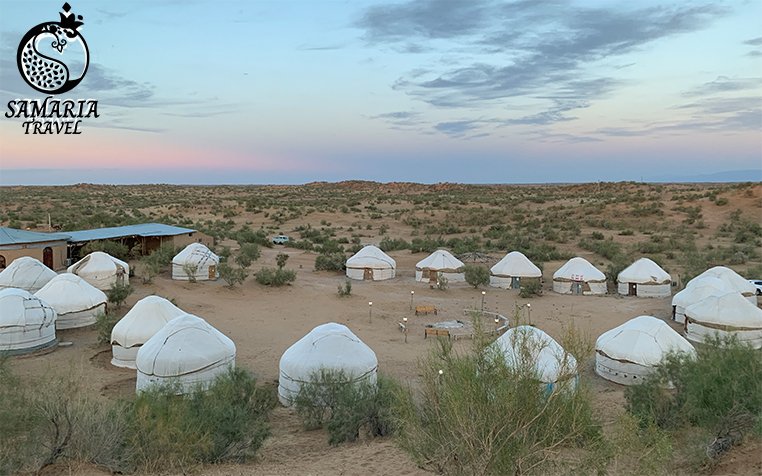
After visiting Lake Aydarkul drive to yurt camp (40 minutes’ drive). Upon arrival, travelers check in to yurt. Travelers sleep in the bed it might be a bit hard and there is an electricity inside of the yurt. Activities to do in yurt camp: camel riding, watching the birds and after dinner live music by Kazakh musician around the campfire.
Overnight in a yurt.
Overnight in Yurt Camp (shared bathroom facilities)
Day 5: After camp-style breakfast, drive to Bukhara (no guide)
After breakfast, depart by road to Bukhara. En route, an optional stop can be made in Gijduvan to visit a traditional pottery center, where guests have the opportunity to meet a local family that has been practicing the art of ceramics for six generations.
Gijduvan is a town which is located 45 km north-eastern of Bukhara. Since ancient times Gijduvan has been known as a craft and trade centre. The incredibly beautiful and truly unique ceramics is a special pride of the town.
Pottery workshop—the family of Alisher Narzullayev is the sixth generation has been making pots in the town of Gijduvan. The guests have a chance to learn more about Gijduvan school of pottery and have guided tour in the pottery centre. This school makes tea cups, bowls and dishes in traditional floral designs of local browns and yellows.
Day 6: Bukhara (city tour with local guide):
The sightseeing in Bukhara city (walking tour. All historical sites are located in close proximity to one another in old town Bukhara; therefore, the sightseeing will be conducted as a walking tour, and no transportation will be used on that day)
Day 7: Bukhara (with transport)
Bukhara city tour outside of the old town (city tour with local guide):
Chor Minor— an unusual madrassah in Bukhara. The name means “Four Minarets”. Each tower has a different decoration.
Naqshbandi Sufism complex— Islamic saint Bakhauddin Naqshband, the famous Asian philosopher and Sufi, the founder of a Sufi order which was later named Naqshbandi, lived in XIV century. He became patron saint and the complex is the holiest site in Bukhara. He made 32 times the Hajj pilgrimage to Mecca and local people consider this place as little Mecca.
The summer palace of Bukhara’s emirs— the palace was built in 1911 for the last emir, Amir Alim Khan, the building compound elements of both Russian and traditional Bukharan architecture.
Ismail Samaniy mausoleum (IX-X centuries)— the oldest, best preserved and most breathtakingly original building in Bukhara.
Optional activity: Visit a traditional hammam in Bukhara for an authentic experience of centuries-old bathing and relaxation rituals. Built during the Shaybanid Dynasty in the 16th century, the hammam remains fully operational and consists of a dressing hall and a bathing hall constructed of baked brick.
Day 8: Bukhara—Khiva by car (no guide)
Transfer to Khiva by car crossing the river Amu Darya (in the antique called Oxus) and the desert Kizilkum.
Arrive to Khiva and check in to hotel.
Day 9: Khiva city tour
Khiva, one of the most ancient cities of Central Asia, has a 2500-year-old history. Khizauv “Fort”, Kheykanik (the name of canal which run in the area), Kheykanik, Kheyvak and Khiva are some the names given to this unique city.
The sightseeing in Ichan Qala Fort Khiva city (walking tour) (city tour with local guide):
Ichan Qala Fort— is a UNESCO World Heritage site since 1990. Present day Ichan Qala is open-air museum. It represents the old part of the city, surrounded with wall and turned into the State Historical Archaeological Museum. The area of Ichan Qala is 26 hectares. The feeling in Inner Fortress transfers people into the past in a city with narrow lanes, low houses, mosques, mausoleums and madrassahs (Quran or Koran schools).
Day 10: Khiva—Urgench transfer to the airport—Tashkent (no guide)
In the morning check out from the hotel and transfer to international airport called Urgench.
Your internal flight is at 10:55 and you reach Tashkent at 12:15 (note please time might change)
When you reach Tashkent transfer to hotel in Tashkent (check in is 14:00)
Day 11: Tashkent. Departure to international airport (no guide)
At 9:30 the driver comes to reception lobby of your hotel and transfer to the airport of Tashkent