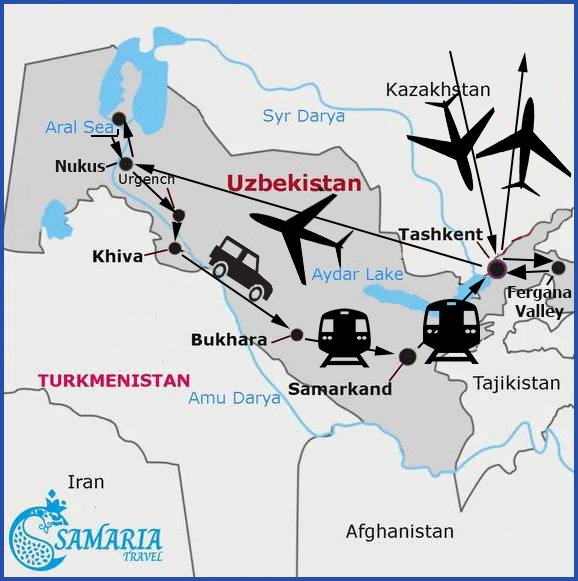
This 14-day private tailor-made guided tour of Uzbekistan is the perfect choice for travelers wishing to explore the country’s most iconic destinations. The journey begins and ends in Tashkent, taking you through the historic Silk Road cities of Khiva, Bukhara, and Samarkand, as well as the scenic Fergana Valley. The itinerary also includes the remote western region of Karakalpakstan and the remarkable Aral Sea, where you will experience an unforgettable overnight stay in a traditional yurt camp on the former shoreline of the sea. Throughout the city tours, you will be accompanied by knowledgeable local guides who will provide fascinating insights into Uzbekistan’s rich history, vibrant culture, architectural heritage, and the daily life and traditions of the Uzbek people, ensuring an authentic and memorable travel experience.
ITINERARY & DETAILS
Day 1: Tashkent arrival. Arrival in Tashkent. Arrival in Tashkent on the first day, allowing travelers to settle in and rest after their flight. Welcome to Uzbekistan. Upon arrival, the driver will meet you outside of the airport with sign of your name and provide a smooth transfer to your hotel for a comfortable and stress-free start to your journey.
Day 2: Tashkent city tour. Tashkent is the capital of Uzbekistan and has approximately 3 million inhabitants. The city is located in the north eastern part of the republic, in the valley where the river Chirchik is located. In the North of Tashkent the snow-covered tops of Big and Small Chimgan mountain can be seen. Tashkent is the fourth largest in the Commonwealth of Independent States after Moscow, St Petersburg and Kiev. The sightseeing in Tashkent city with local guide: Earthquake Memorial— this memorial is devoted to the tragic date of earthquake in Tashkent on April 26th of 1966 and is erected in the approximate spot of the earthquake epicenter. Khazrati Imom Complex (XVI-XX centuries) the historical spiritual heart of the city (consists of functioning Friday mosque “Khazrati Imom Mosque” from 2007, Barak-Khan Madrassa from XVI-XVIII centuries—present-day serving as shopping place, Tellya Sheikh Mosque from XIX century. The market Chorsu (“four roads” in Uzbek, the commercial heart of the city and has been for hundreds of years). Metro riding (the only Central Asian Underground, built in 1977). Amir Timur Square, the heart of modern Tashkent, is a beautifully landscaped park surrounded by the city’s most important political and cultural landmarks. At its center stands the equestrian statue of Amir Timur (Tamerlane), while the surrounding area includes the Hotel Uzbekistan, the Amir Timur Museum, the Tashkent Clock Towers, the University of Law, and the Uzbekistan Forums Palace.
Day 3: Tashkent—Margilan by train. Early morning your driver will meet you at reception lobby of your hotel in Tashkent at 07:10 transfer to the train station and the train leaves at 08.10 am (on the way train stations: Orzu, Pop, Kokand, Margilan) and reaches Margilan at 13.23. Meet your local guide and driver and start sightseeing tour in Fergana Valley. The sightseeing in Margilan. Nowadays the majority of silk is made large factories and most of these are in China. However, it is still possible to see traditional methods of weaving along the Silk Road. One of the best-known places is in Margilan in the Fergana Valley, where visitors are welcome to tour in a small factory. The sightseeing in Rishtan. Rishtan town is famous for its blue-and-green ceramics and the oldest center of ceramic art in Central Asia. Visit one of the pottery studios of the town. The sightseeing in Kokand: Palace of Khudáyár Khán: the most impressive sight of Kokand is the Khudayar Khan Palace , one of the most glittering royal residences in Central Asia. The Palace originally had got 113 rooms set around seven courtyards and this days visiters can visit 19 of rooms which is remained. Jami Mosque: Juma Mosque in Kokand was built by King Umar Khan between 1809 and 1812, and it was the khan’s primary place of worship. The mosque remained shut for most the 20th century, but reopened after much-needed restoration in 1989. There is a minaret and 98 glorious redwood columns, carved and imported from India.
Day 4: Kokand—Tashkent by car through mountain pass (no guide) Meet your driver at reception lobby of your hotel at 11:00 am and transfer to Tashkent through Kamchik Mountain Pass and drop off at Tashkent domestic airport and take a flight to Nukus. Tashkent departure time is 20:00. Nukus arrival time is 21:40. Travelers will fly with Uzbekistan Airways. Each passenger is entitled to one checked bag with a maximum weight of 23 kg and one carry-on bag with a maximum weight of 5 kg. Passengers are permitted to bring water on board after it has passed through the airport security screening. When you land to Nukus the driver will meet you outside of airport with the sign of your name and transfer to hotel in Nukus.
Day 5: Nukus – Mizdakhan— Muynak – Usturt Plateau – Aral Sea (with local guide). Nukus is the center of Karakalpakstan an autonomous republic, which is located in the north-western part of Uzbekistan. Adventure tour to Aral Sea starts with a convenient hotel pickup in Nukus travel to Muynak. After Muynak and the first stop of the Aral Sea tour will be in Muynak town, where travelers visit “Cemetery of ships”, the harbor without a sea, and next visit Muynak Regional Studies Museum (might be closed without prior notice). Then lunch break at the guesthouse. Continue driving on the boundless Ustyurt Plateau. Travelers reach the Aral Sea in the late afternoon. Along the way travelers have a great spot to take pictures of beautiful canyons and the collapsed land. Arrive in a yurt Camp. Camp-style dinner. Overnight in the yurt. Meals: Dinner
Day 6: Aral Sea – Sudochie lake – Nukus. If you are an early bird so you can take an amazing picture of sun rise. After breakfast a short visit the settlement of Kurgancha-Kala dating back to the 13th century. Then drive via Kungrad district, which used to be one of the trading centers on the Silk Road. On the way, see remains of a lighthouse; pass by the ruins of abandoned settlement Urga. Photo stop at Lake Sudochie. Lunch break (a picnic style or in local café) and drive to Nukus. Overnight in Khiva.
Day 7: Nukus – Khiva transfer (no guide). After breakfast, your driver will meet you in the reception lobby of your hotel and transfer you to Khiva.
Day 8: Khiva city tour. Khiva, one of the most ancient cities of Central Asia, has a 2500-year-old history. Khizauv “Fort”, Kheykanik (the name of canal which run in the area), Kheykanik, Kheyvak and Khiva are some the names given to this unique city. The sightseeing in Ichan Qala Fort (walking tour with local guide): Ichan Qala Fort— is a UNESCO World Heritage site since 1990. Present day Ichan Qala is open-air museum. It represents the old part of the city, surrounded with wall and turned into the State Historical Archaeological Museum. The area of Ichan Qala is 26 hectares. The feeling in Inner Fortress transfers people into the past in a city with narrow lanes, low houses, mosques, mausoleums and madrassahs (Quran or Koran schools).
Day 9: Khiva— Bukhara by car (no guide). Transfer from Khiva by car crossing the river Amu Darya (in the antique called Oxus) and the desert Kizilkum. Arrive to Bukhara and check in to hotel.
Day 10: Bukhara city tour. Bukhara, one of the most ancient cities of Central Asia, has a 2500-year-old history. Bumichkat “New Castle”, Al Madina as-sufriyya “Copper City”, Madinat at-tujjor “City of Traders”, Foxira “Honorable City” are some the names given to this unique city. The sightseeing in Bukhara city (walking tour with local guide). Labi Hauz Complex (“The edge of the pond” from Persian) constructed by Nadir Divan Begi, The Grand Vizier of Bukhara, around 1620. Statue of Hodja Nasruddin— the homespun philosopher and humourist on his donkey. Elsewhere in the world he is generally accepted as Turkish, but Uzbeks claim he was born in Bukhara and is one of their own. Poi Kalon complex (“The foot of tall” in Uzbek) from XII-XVI centuries. Consisting of mosque, madrassah and minaret, one of the great centre of trade and scholarship along the Silk Road. The beauty of the minaret amazed Genghis Khan (Temuchin or Temujin). Trading domes—Tok-i-Zargaron (1570, Jewellers’ Bazaar), which once cornered the local market in lapis and rubies from Badakhsan. Tok-i-Tilpak Furushon, or Cap Makers’ Bazaar, which once specialized in gold-embroired skullcaps, fur hats and illustrated manuscripts, all of which had to be protected from the glare of the sun. Tak-i-Sarrafon—money changers’ dome.Abdulazizkhon Madrassa, constructed in 1652, was commissioned to commemorate the ruler’s victory over the Mughal army in Balkh. Occupying a footprint of 60 by 48 meters, the complex is distinguished by its sumptuous decorative programme, featuring vibrant mosaic work in a profusion of colours and complemented by equally striking ganch stalactites that enhance the architectural splendour of the site.The Citadel Ark (I-XX centuries)— (visit from outside) the construction of the citadel is dated to beginning of the 1st millennium BC. During the history the fortress has been destroyed several times but has been restored again. All buildings of the citadel have been reconstructed mainly during the XVIII-XX centuries.
Day 12: Samarkand city tour (with local guide). Samarkand, one of the most ancient cities of the world, a contemporary of the Rome, Athens and Babylon, has a 2750-year-old history. “The Mirror of the World”, “The Garden of the Soul”, “The Jewel of Islam”, “The Precious Pearl of the Moslem World” are some the names given to this unique city. In ancient Greece, this city was known as Marakanda. Gur-Amir mausoleum (“the tomb of the king” in Uzbek) must see sight in Samarkand from XV century the final resting place of Temir. The mausoleum was originally planned for temur’s favourite grandson, Muhammad Sultan but Samarkand was deemed a more fitting resting place. Registan square (“sandy place” in Uzbek) from XV-XVII centuries. A spectacular architectural ensembles, with fantastic Islamic designs and calligraphy etched into the facades of its mosques and madrassahs. Ulugbek Madrasah built between 1417 and 1420 is the oldest madrasa in Registan square. This construction work was carried on under Ulugbeg (the Astronomer King, the author of astronomic tables known throughout the world), Temur’s grandson, who was both an eminent ruler and scholar. Tilya-Kori Madrasah means Gold-covered madrasa was built in XVII century in Registan square. This is the one madrasa the travelers must go inside: the golden ceiling of the mosque, to the left of the courtyard, is utterly enthralling, and it is this gilt that gives the madrasa its name. Sher Dor Madrasah means the tiger or lion madrasa built between 1619 and 1636 by Yalangtush Biy, must be one of the most-photographed buildings in existence. Bibi Hanim mosque XV century. The mosque was built in honour of Temur’s chief wife, Saray Mulk Khanum. Local Siab market (“black river” in Uzbek). Travelers can find in this market spices, fresh and dry fruits and different souvenirs.
Day 13 (September 26): Samarkand city tour (with local guide) and afternoon take the train to Tashkent 16:56—19:17 (not please the train time might change). Samarkand Handmade Paper Centre— for centuries Samarkand was famous for its mulberry paper and famed for its durability and resistance to insects. Production died out in the 18th century and this UNESCO backed project in the eastern suburbs aims to revive the 2000-year-old tradition. Guests can see process of making Samarkand paper from mulberry bark. The Ulugbek Observatory, built by Amir Temur’s grandson astronomer-king Ulugbek in XV century. The museum of Afrasiab (the history museum of Samarkand and the highlight of this place is the original frescos of Turk Khanate “Turk kingdom” from VII century). The complex Shahi Zinda (“alive king” in Uzbek) from XII-XX centuries. Burial place of royal persons and nobles. One of the most spiritual places in Uzbekistan. After the tour transfer to railway station of Samarkand and take the train to Tashkent. Departure from Samarkand at 16:56. Arrival to Tashkent at 19:17 (not please the train time might change). When you reach Tashkent, the driver will meet you with the sign of your name from railway station of Samarkand and transfer to your hotel.
Day 14: Tashkent. Departure. Transfer from your hotel to international airport of Tashkent.
A tailor-made guided tour of Uzbekistan is the ideal choice for families, friends, or small groups seeking a personalized travel experience at their own pace, with the flexibility to explore renowned destinations such as Tashkent, Khiva, Bukhara, and Samarkand, as well as lesser-visited regions including the Fergana Valley and the Aral Sea; to prepare a customized itinerary, we kindly ask you to provide the number of travelers, your preferred hotel category (3-star, 4-star, 5-star, or centrally located boutique hotels), room type (twin, double, or triple), arrival and departure cities and times, and any dietary requirements or food allergies.