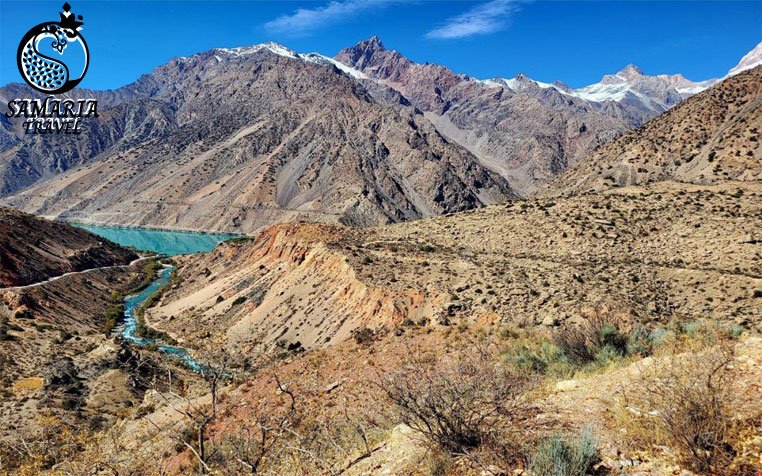
Tajikistan tour from Tashkent offers an excellent opportunity to discover some of the country’s most remarkable destinations, including Khujand, Iskandarkul Lake, and Penjikent. This journey combines cultural exploration with breathtaking natural landscapes, providing travelers with a rich and memorable travel experience.
Day 1: Tashkent (border cross) – Khujand city tour
Pick up at 8:00 am from Tashkent hotel. Transfer from your hotel in Tashkent to the border, which takes approximately one hour and forty minutes. Cross the border on foot through the Uzbek and Tajik checkpoints, a process of around 40–50 minutes. Upon entering Tajikistan, your driver and guide will meet you with a sign bearing your name, and your journey in Tajikistan begins.
Khujand is recognized as one of the most ancient cities of Central Asia, with some sources tracing its foundation to the 7th–6th centuries BC. It was conquered by Alexander the Great, who rebuilt, fortified, and renamed it Alexandria Eskhata, meaning “the Farthest Alexandria.” Strategically located along the Great Silk Road, connecting Samarkand with the Fergana Valley, Khujand held a highly advantageous geopolitical position and played a vital role in regional trade and transport. In the 8th century, the city was taken by the Arabs, and in the 13th century, it resisted the Mongol invasion led by Genghis Khan, though it was ultimately destroyed. Despite this devastation, Khujand soon revived and developed into one of the foremost commercial, cultural, and scientific centers of Central Asia. Today, it continues to serve as a key industrial, scientific, and cultural hub of northern Tajikistan, preserving its historical significance while adapting to modern progress.
After the city tour in Khujand, you will be transferred to your hotel in Khujand.
Day 2: Khujand city tour – Istrafshan – Iskanderkul (overnight in guest house)
After breakfast check out from the hotel and start the journey to Iskandarkul via Istrafshan.
In 2002, Istaravshan celebrated its 2,500th anniversary, underscoring its distinguished historical legacy. According to tradition, the city was founded by Cyrus the Great as Kurushkanda, serving as a fortress guarding the strategic Shahristan Pass between the Syr Darya and Zeravshan valleys. It is also recognized as the place where Alexander the Great sustained his first wound after conquering Persia. Though later destroyed, Alexander rebuilt and renamed the city Cyropolis in honor of Cyrus, acknowledging its strategic significance.
Mugteppa was once the residence of local nobility, who built palaces distinguished by unique architectural styles. As one of the oldest settlements of Istaravshan, archaeological findings at Bundzhikat and Chil’khudzhra reveal fortified complexes with richly decorated palatial and religious structures. A notable discovery in Bundzhikat—a mural of a she-wolf nursing two infants—symbolizes cultural connections between East and West. Today, only a domed gate with columns remains on Mug Hill, marking the former governor’s residence. During the Arab period, Istaravshan became part of the Caliphate, fostering the development of Islamic architecture, including mosques, madrasahs, mausoleums, and minarets.
Iskanderkul Lake, one of Tajikistan’s most picturesque natural wonders, is nestled within the Fann Mountains in the Sughd Province. Known for its stunning turquoise waters, the lake sits at an elevation of approximately 2,195 meters, making it one of the highest lakes in the region. Surrounded by towering peaks and dense forests, Iskanderkul is not only a significant attraction for nature enthusiasts but also plays a vital role ecologically, providing a habitat for various species of flora and fauna.
Iskanderkul overnight in guest house
Day 3: Iskanderkul Lake – Penjikent – Jartepa (border cross) – Samarkand
After breakfast start the journey to Samarkand via Penjikent.
Penjikent is northern Tajikistan’s main archaeological site. This rich, cosmopolitan place thrived on the banks of the Zarafshan River until destroyed by Arab invaders in 722. Silk cocoons were unearthed at the site during excavations.
Sarazm is located 20 km west of Penjikent city and it is one of the oldest settlements in Central Asia, where archaeologists have unearthed a Bronze Age temple complex and 2,500-year-old grave of a wealthy woman.Then drive back to Samarkand border for departure. After crossing the border the driver from Samarkand side will meet you and transfer to your hotel.
Penjikent Bazaar: This bazaar has a beautiful central building ringed by brick archways. It’s a good place to stock up on trekking snacks like nuts and dried fruits, or get your first taste of Tajik hospitality.
After the tour transfer to the border. Cross the border on foot through the Tajik and Uzbek checkpoints, a process of around 40–50 minutes. Upon entering Samarkand, your driver will meet you with a sign bearing your name, and transfer to your journey in Samarkand.