Uzbekistan tour, arriving in Urgench and departing from Tashkent
5/5 - (5 votes)
Uzbekistan tour, arriving in Urgench and departing from Tashkent. Travelers arrive in Urgench and proceed to Khiva for a comprehensive city tour, exploring its rich historical and architectural heritage. Following the visit to Khiva, the journey continues by car to Bukhara, where travelers discover the well-preserved Old Town and its significant cultural landmarks. After completing the tour of Bukhara, they travel by high-speed Afrosiyob train to Samarkand, a UNESCO World Heritage city renowned for its monumental sites. Upon finishing the Samarkand city tour, travelers continue by high-speed Afrosiyob train to Tashkent, where the tour of Uzbekistan concludes. This itinerary is ideally suited for travelers who wish to explore Uzbekistan at a relaxed pace while enjoying the comfort and efficiency of high-speed Afrosiyob train travel between major cities.
Day 1: Urgench transfer to Khiva
Arrival in Urgench. Met in front of the arrival building of the airport by driver and guide transfer to Khiva.
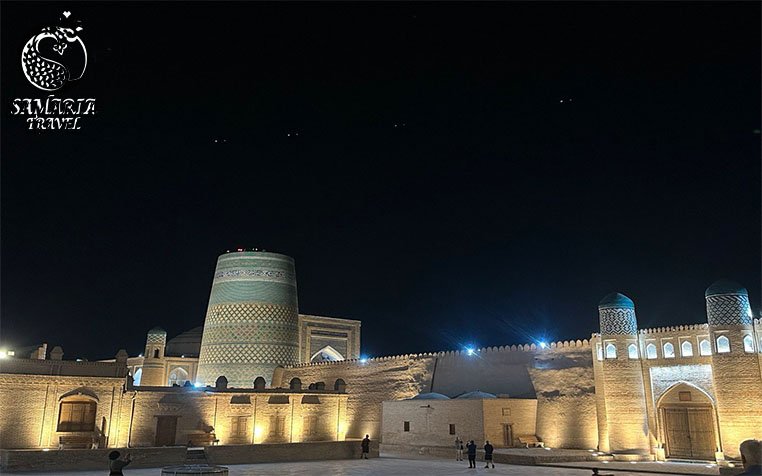
Khiva, one of the most ancient cities of Central Asia, has a 2500-year-old history. Khizauv “Fort”, Kheykanik (the name of canal which run in the area), Kheykanik, Kheyvak and Khiva are some the names given to this unique city.
The sightseeing in Ichan Qala Fort (walking tour with local guide):
Ichan Qala Fort— is a UNESCO World Heritage site since 1990. Present day Ichan Qala is open-air museum. It represents the old part of the city, surrounded with wall and turned into the State Historical Archaeological Museum. The area of Ichan Qala is 26 hectares. The feeling in Inner Fortress transfers people into the past in a city with narrow lanes, low houses, mosques, mausoleums and madrassahs (Quran or Koran schools).
Day 2: Train from Khiva to Bukhara 15:15—21:22
Train from Khiva to Bukhara. Arrive to Kogon town. The driver will meet you with the sign of your name and transfer to Bukhara city (10 km).
Day 3:Bukhara
The sightseeing in Bukhara:
The summer palace of Bukhara’s emirs (Setorai Moxi Xossa) — the palace was built in 1911 for the last emir, Amir Alim Khan, the building compound elements of both Russian and traditional Bukharan architecture.
Naqshbandi Sufism complex— Islamic saint Bakhauddin Naqshband, the famous Asian philosopher and Sufi, the founder of a Sufi order which was later named Naqshbandi, lived in XIV century. He became patron saint and the complex is the holiest site in Bukhara. He made 32 times the Hajj pilgrimage to Mecca and local people consider this place as little Mecca.
Chor Bakr Necropolis—In 970 Imam Sayid Abu Bakr and his three brothers Fazl, Ahmed and Hamed, all direct descendents of the Prophet, were laid to rest in the village of Sumitan, seven kilometers west of Bukhara. They instilled the site with an immediate sanctity that soon attracted legions of the rich and famous claim and famous clamoring to claim holiness by association.
Day 4: Bukhara to Samarkand by train
15:03-16:46 (note please train time might change)
Check out time is until 12:00
Day 5: Samarkand
Samarkand, one of the most ancient cities of the world, a contemporary of the Rome, Athens and Babylon, has a 2750-year-old history. “The Mirror of the World”, “The Garden of the Soul”, “The Jewel of Islam”, “The Precious Pearl of the Moslem World” are some the names given to this unique city. In ancient Greece, this city was known as Marakanda.
The sightseeing in Samarkand city:
The museum of Afrasiab (the history museum of Samarkand and the highlight of this place is the original frescos of Turk Khanate “Turk kingdom” from VII century).
Mausoleum of Daniyar— everyone has heard of Daniel and the lion’s den, but few could tell that his final resting place. He is considered a patron saint and protector of Samarkand, bringing wealth and prosperity to the city. According to legends Amir Temur supposedly brought some sand from his mausoleum here from Susa in Iran and built symbolic mausoleum for honor of him.
The Ulugbek Observatory (Ulugh Beg Observatory), builtby Amir Temur’sgrandson astronomer-king Ulugbek in XV century.
The complex Shahi Zinda (“alive king” in Uzbek) from XII-XX centuries. Burial place of royal persons and nobles. One of the most spiritual places in Uzbekistan.
Gur-Amir mausoleum (“the tomb of the king” in Uzbek) must see sight in Samarkand from XV century the final resting place of Temir. The mausoleum was originally planned for temur’s favourite grandson, Muhammad Sultan but Samarkand was deemed a more fitting resting place.
Day 6: Samarkand – Shakhrisabz – Samarkand
The sightseeing in Shakhrisabz city:
Ak Saray Palace (“a white palace” in Uzbek) built in 1380-1404. Amir Temur gathered its craftsmen to his hometown to build his greatest palace, similar in structure to Samarkand’s Bibi Khanum Mosque. The name Ak-Serai (White Palace) symbolizes his noble descent, not the dominant colour, for blue, green and gold patterned the vast mosaics.
Statue of Amir Temur— there are three huge statues of Temur: one is in Samarkand, one is in Tashkent and the third is in his hometown Shakhrisabz in standing position. The bronze statue weighs 20 tons and 9 meters high built after the Independence (1991).
Complex of Dor-us Siyadat (“place of sadness” in Uzbek) from XIV century. Itarose on the death of his eldest and favorite son Jahangir, killed in 1375 (aged only 22). When another son, Umar Sheikh, joined Jahangir in 1394, Temur even built himself a crypt.
Dor-ut Tilavat (“place of praying” In Uzbek) from XIV-XV centuries, contains the Kok Gumbaz Mosque (1435) built by grandson of Temur Mirzo Ulugbek, the mausoleum constructed by Amir Temur in 1373-1374 for Sheikh Shamseddin Kulyal, a Sufic leader and spiritual advisor of Temur’s father , Taraghay.
Day 7: Samarkand to Tashkent by train
Check out from the hotel. City tour and transfer to railway station.
Registan square (“sandy place” in Uzbek) from XV-XVIIcenturies. A spectacular architectural ensembles, with fantastic Islamic designs and calligraphy etched into the facades of its mosques and madrassahs.
Ulugbek Madrasah built between 1417 and 1420 is the oldest madrasa in Registan square. This construction work was carried on under Ulugbeg (the Astronomer King, the author of astronomic tables known throughout the world), Temur’s grandson, who was both an eminent ruler and scholar.
Tilya-Kori Madrasah means Gold-covered madrasa was built in XVII century in Registan square. This is the one madrasa the travelers must go inside: the golden ceiling of the mosque, to the left of the courtyard, is utterly enthralling, and it is this gilt that gives the madrasa its name.
Sher Dor Madrasah means the tiger or lion madrasa built between 1619 and 1636 by Yalangtush Biy, must be one of the most-photographed buildings in existence.
Bibi Hanim mosque XV century. The mosque was built in honour of Temur’s chief wife, Saray Mulk Khanum.
Local Siab market (“black river” in Uzbek)— (optional on the interests of your private group, note: Closed on Monday)
Day 8: Tashkent city tour
The sightseeing in Tashkent city:
Tashkent is the capital of Uzbekistan and has approximately 3 million inhabitants. The city is located in the north eastern part of the republic, in the valley where the river Chirchik is located. In the North of Tashkent the snow-covered tops of Big and Small Chimgan mountain can be seen. Tashkent is the fourth largest in the Commonwealth of Independent States after Moscow, St Petersburg and Kiev.
Earthquake Memorial— this memorial is devoted to the tragic date of earthquake in Tashkent on April 26th of 1966 and is erected in the approximate spot of the earthquake epicenter.
Center for Islamic Civilization — situated in the historic Hazrati Imam Complex in Tashkent, is a major cultural and research institution dedicated to preserving the nation’s Islamic heritage. Featuring a grand 65-meter dome, it combines traditional design with modern architecture and includes a museum, a rich library of manuscripts, and research facilities. The center highlights Uzbekistan’s significant contributions to Islamic science, culture, and spirituality, serving as a symbol of national pride and intellectual legacy.
Khazrati Imom Complex (XVI-XX centuries) the historical spiritual heart of the city (consists of functioning Friday mosque “Khazrati Imom Mosque” from 2007, Barak-Khan Madrassa from XVI-XVIII centuries—present-day serving as shopping place, Tellya Sheikh Mosque from XIX century, Muyi Moborak Library— holds rare Oriental manuscripts collection.
Themarket Chorsu (“four roads” in Uzbek, the commercial heart of the city and has been for hundreds of years).
Day 9: Tashkent city tour and departure
Metro riding (the only Central Asian Underground, built in 1977).
Amir Timur Square—the centre of the modern city, is green space with plenty of flowers and fountains. The square covers the most important buildings both political and cultural. In the middle of the square is the statue of Amir Timur (known in Europe as Tamerlane) on horseback, hotel “Uzbekistan” which was built in 1974, University of Law (former Women’s Gymnasium), Museum of Amir Timur, well-known Tashkent Clock Towers (the first tower was constructed in 1947 to house the clock mechanism from Eastern Prussia, a war trophy brought back to Tashkent by watchmaker Ayzenshteyn), and Uzbekistan Forums Palace.
Independence Square (Mustaqillik Maydoni)— is one of the largest square in the city. It is packed with monuments and fountains, and the most important monument is the golden globe representing the independence of Uzbekistan and a mother with a child in her arms. One of the interesting corners of the square is Crying Mother Statue devoted to the honor of 430,000 Uzbek soldiers who died in the World War II.
After the tour transfer to the airport of Tashkent