One day castle tour from Elikkala station to Khiva hotel
5/5 - (5 votes)
Kala Tour from Ellikala to Khiva. Visit some of the most significant attractions beyond Khiva on an excursion to Guldursun Qala, Kyzyl Qala (“Red Fortress” in Uzbek), Toprak Qala (“Sand Fortress”), and the renowned desert stronghold of Ayaz Qala.
In the semi-desert regions east and north of Urgench, in southern Karakalpakstan, lie the ruins of more than a dozen ancient walled towns, palaces, and fortresses, many of which date back over 2,000 years. This area is traditionally known as Ellik Qala (“Fifty Fortresses”), a name that vividly reflects the remarkable archaeological heritage buried beneath the desert sands. Of the approximately twenty remaining fortresses, this tour includes visits to four of the most impressive sites, notably Toprak Qala and Ayaz Qala.
The sightseeing in Qala trip (“Fortress” in Uzbek):
Guldursun Qala — was constructed, or extensively reconstructed, during the 12th and 13th centuries. It is one of the largest fortresses in the region, featuring perimeter walls measuring just over one kilometer in length and enclosing an area of approximately 6.4 hectares (64,000 square meters, or 15.8 acres).
Kyzyl Qala (“Red fortress” in Uzbek)— located in modern Karakalpakstan, Uzbekistan and it was an ancient fortress in Khorazm built in the 1st -4th centuries AD. Kyzyl Qala fortress buried in the desert for centuries before being discovered by Professor Tolstov in 1938.
Toprak Qala (“Sand” in Uzbek)— used to be the region’s biggest city (350 meters by 500 meters) until the destruction canals left it marooned in the desert sands. The Russian archaeologist Tolstov excavated the palace friezes in 1938 dating from the 2nd and 3rd century AD.
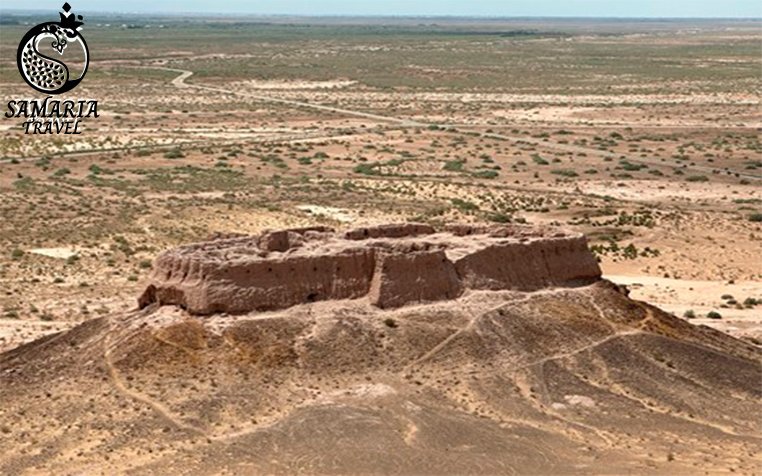
Ayaz Qala— is a “must see” fort in the desert. The external walls, built upon a flat hilltop, have survived since at least the 4th century BC, the guests can clearly see the scale of the site and even today sections of wall survive that are 10 meters high. After forts sightseeing transfer to the Khiva.